
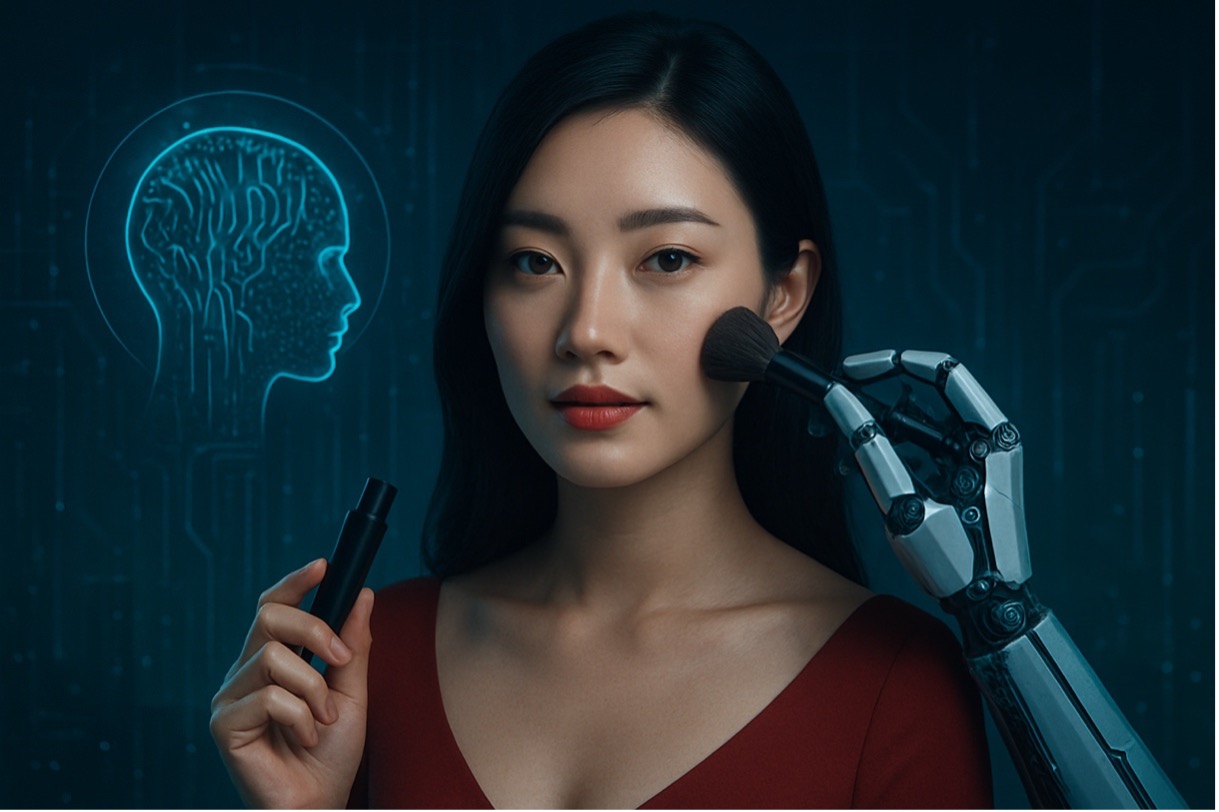
AI in China’s beauty industry is rapidly becoming a core component. It is reshaping how consumers discover products, understand efficacy, and make purchasing decisions, encompassing everything from ingredient analysis and AI-powered skin diagnosis to AI-assisted livestreaming. For brands, these tools shorten research and development (R&D) cycles and the path from insight to action, enabling scalable growth. China possesses unique advantages to lead this transformation, as beauty consumption is already highly digitized with smartphone penetration exceeding 68%. Platform ecosystems integrate content, communities, and e-commerce into a closed-loop model that continuously generates consumer signals.
Download the 2026 China Beauty Report here
Macroeconomic data support that China’s beauty market has become highly digitized
In 2025, China’s National Bureau of Statistics (NBS) reported cosmetics retail sales of RMB 456.3 billion, a 5.1% year-on-year increase. While the China Association of Fragrance Flavor and Cosmetic Industries reported that the all-channel cosmetics transaction value exceeded RMB 1.1 trillion, up 2.83% year on year. The gap is mainly definitional. The NBS figure is an official retail revenue statistic, whereas the association figure reflects a transaction-value measure closer to gross merchandise value (GMV) and typically without deducting sales costs incurred during the sales process. This is important because it highlights the category’s structural digitality. Within the omnichannel retail transaction volume, online channels accounted for RMB 721.773 billion, growing 4.45% year-on-year and representing 65.36% of the total.
By comparison, online retail sales of physical goods nationwide accounted for only 26.1% of total consumer-goods retail in 2025, highlighting e-commerce’s particularly high penetration rate in the cosmetics sector. Brands gain access to rich consumer data and touchpoints, thereby providing robust support for the development of artificial intelligence algorithms. Leading platforms such as Tmall, Douyin, and RedNote (Xiaohongshu) have built ecosystems that integrate discovery, shopping, and feedback, creating an ideal environment for AI tools, including recommendation engines, computer vision, and chatbots, to learn at scale from real-time consumer behavior.
In daily life, the widespread adoption of facial recognition technology (for payments and face ID) has lowered barriers to AI facial analysis applications in the beauty sector. Moreover, Chinese consumers are known for being discerning and detail-oriented: they seek data, user reviews, and relevant evidence before making purchases. Consequently, AI tools that deliver personalized, data-driven recommendations align closely with local consumers’ decision-making processes.
Market size and growth outlook for AI in China’s beauty industry
Currently, the AI-driven “beauty tech” segment remains in its early stages but possesses significant potential for rapid expansion. AI in China’s beauty market encompasses revenue from AI skincare devices, virtual makeup trials, skin diagnostic software, personalized cosmetic services (due to regulatory restrictions, personalized products currently remain pilot projects), and related retail technology applications. In 2024, China’s beauty tech market (including AI, augmented reality, and wearable technologies) generated revenue of USD 5.639 billion (approximately RMB 39.146 billion).
While this represents only a relatively small fraction of total beauty product sales, it accounted for 8.58% dividing by NBS cosmetics retail sales (RMB 456.3 billion). This signals an emerging trend: AI applications are being commercialized early in the sector. AI accounted for the largest share of the beauty tech market, at 48.82%. Multiplying this figure by the beauty market data mentioned earlier, we estimate that AI in China’s beauty market is approximately RMB 19.111 billion in 2024.
Projections indicate that AI in China’s beauty market will grow rapidly from 2025 to 2030, with a compound annual growth rate (CAGR) of 22.4%. This expansion will be driven by: broader consumer acceptance of AI-enhanced products, increased corporate investment in AI, and technology-driven premiumization of beauty consumption. In the future, more consumers may purchase smart skincare devices or pay for AI-guided dermatological consultations via apps.
Ingredient transparency and dermatological validation
Chinese consumers are increasingly prioritizing ingredients and adopting a science-driven approach when selecting beauty products, a trend sometimes referred to as the rise of the “ingredient-focused consumer” (“成分党”). Gen Z and younger millennial shoppers scrutinize ingredient lists (INCI) like amateur dermatologists, seeking scientifically backed efficacy. Data indicate that more than 58% of Chinese beauty consumers now rank ingredient and formulation efficacy as their top purchasing criteria. To meet consumer demand, leading domestic skincare brands such as Winona and Proya are building their brand identities around scientific research.
Winona: a leader in meeting consumer demand for ingredient transparency
Winona‘s brand narrative consistently addresses dermatological pain points, including sensitive skin, compromised skin barrier function, photoaging, and melasma, positioning product development to meet clinical needs. By adhering to the NUTE (need, unique, technology, evidence) principle, Winona’s dermatology experts pioneered the discovery linking sensitive skin to barrier dysfunction, enabling the industry and consumers to truly understand why skin becomes sensitive.
Over the past decade, Winona’s special care line has been the subject of more than 56 clinical studies and has been reported in 79 scientific papers, providing robust, evidence-based support. They treat these clinically validated publications as brand promotional materials rather than merely internal R&D documents. In 2025, Winona announced that it had obtained a market position statement from Frost & Sullivan, confirming its position as the top seller in China’s sensitive skin care market for five consecutive years (2020-2024).
How consumers use AI tools to help identify ingredients
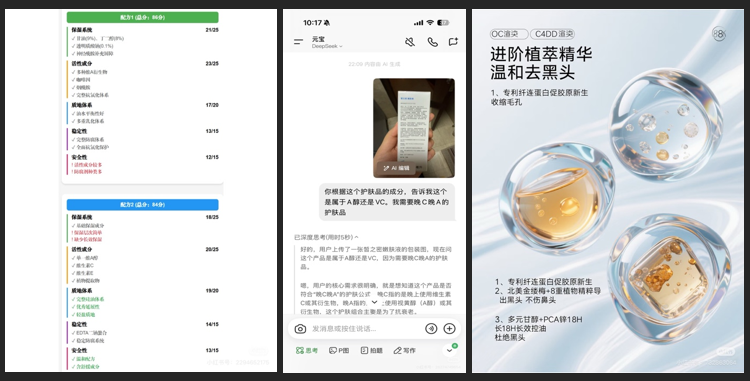
Against this backdrop, consumers are increasingly turning to AI tools to help analyze product ingredients. While apps such as Beauty Evolution (美丽修行) specialize in providing ingredient lists for beauty products, users on social media have expressed widespread dissatisfaction with the app’s slow updates to ingredient lists and excessive advertising, prompting them to seek alternatives. AI chatbots are distinguished by their powerful information retrieval capabilities. For any legitimate product with accurate registration information, users can request large models to proactively analyze it and obtain insights into its ingredients. These tools can even generate visualizations of ingredient lists, offering clearer and more concise information.
AI-powered skin diagnosis
As consumers increasingly prioritize skin health, they are experimenting with various AI skin analysis tools to obtain skincare recommendations. Currently, no dominant player exists in the AI skin analysis app space, with offerings primarily consisting of AI chatbots or built-in features from smartphone manufacturers like Huawei’s Mirror AI. However, consumer feedback indicates that results derived from smartphone cameras are often questioned for accuracy. This is because online AI analysis relies solely on facial images, which can be significantly affected by factors such as image quality, lighting conditions, and camera algorithms. Such variables often lead to substantial discrepancies in results, making them unreliable as professional references.
In contrast, offline brand flagship stores such as Kiehl’s and Lancôme use specialized skin diagnostic equipment to provide accurate assessments. During its November 2025 R&D Open Week event, L’Oréal China showcased its latest Cell BioPrint hardware, which leverages proteomics to deliver personalized skin analysis within five minutes. Currently, AI skin analysis apps are more likely to serve as novelty features that enhance consumer engagement rather than as major commercial products.

How far are we from AI-driven personalized products?
Beauty product consumption is becoming increasingly scenario-based, tailored to individual skin types, lifestyles (e.g., frequent travel or outdoor activities), and local climates. Consumers increasingly expect products and recommendations to align with their unique needs, whether it is skincare regimens adapted to their environment or makeup shades precisely matched to their skin tone. This demand for AI-driven personalization thrives in fertile ground. Such individualized expectations are closely tied to consumers’ digital literacy, as they routinely rely on online tools to guide their beauty choices.
Challenges and opportunities in the personalized cosmetics market
Despite China’s vigorous push for cosmetic regulatory reform in recent years, personalized cosmetics remain confined to pilot projects. This is primarily due to the multiple challenges these products face, including full-lifecycle management from raw materials through to rigorous safety assessments. Relevant regulations stipulate that starting May 1, 2024, all cosmetics must undergo comprehensive safety evaluations, followed by toxicological assessments for each ingredient used in the formulation to further ensure product safety. Additionally, starting May 1, 2023, cosmetic efficacy evaluation became mandatory. Unless exceptions apply, different cosmetic efficacy claims require different forms of efficacy data support.
The good news is that China is gradually advancing the pilot implementation of such projects. In November 2022, the National Medical Products Administration (NMPA) first approved the pilot of customized cosmetic services in Beijing, Shanghai, Zhejiang, Shandong, and Guangdong, including skin testing, product tracking, and customized skincare services. On September 17, 2025, China’s NMPA announced the launch of Phase II of the personalized cosmetics pilot program. Starting October 1, 2025, designated enterprises in 15 regions (including the five Phase I regions) will be authorized to provide on-site formula customization services for general cosmetics that have already been filed. This program will run for two years.
L’Oréal Group and Estée Lauder Companies have also begun exploring personalized services in China, such as customized serums and on-site perfume blending. Bloomage Biotech launched AI-assisted personalized skincare services at its Qingdao-based BIOHYALUX store by the end of 2024. Although the market remains nascent, the personalized cosmetics sector is poised for renewed growth opportunities in China within the foreseeable future, driven by evolving regulatory frameworks and sustained consumer demand.
What this means for beauty players in 2026:
- China’s beauty market is already structurally digital, creating a natural runway for AI at scale. Online cosmetics transactions totaled RMB 721.8B and accounted for 65.36% of all-channel transactions, compared with 26.1% online share in national physical-goods retail, providing brands with richer touchpoints for AI learning.
- Ingredient transparency is becoming a top priority, and AI is increasingly being incorporated into the decision-making process. As consumers scrutinize INCI lists and complain about slow-updating ingredient apps, they increasingly use AI tools to parse barcodes, ingredients, and claims more efficiently.
- Science-led domestic brands are turning research assets into signals of brand identity. Winona’s sensitive-skin positioning, clinical studies, and published research illustrate how their branding aligns with the ingredient-focused consumer trend.
- AI skin diagnosis is popular as engagement, but credibility constraints cap its current commercial role. Camera-based diagnostics are sensitive to lighting and device variation, so consumers often treat them as reference or entertainment, while professional-grade hardware remains concentrated in flagship stores and events.
- Personalized cosmetics are advancing, but regulation necessitates a gradual approach. Despite mandatory safety and efficacy requirements, personalization remains largely in pilots’ hands and tends to focus on compliant on-site customization services rather than on fully bespoke ingredient innovation at scale.