

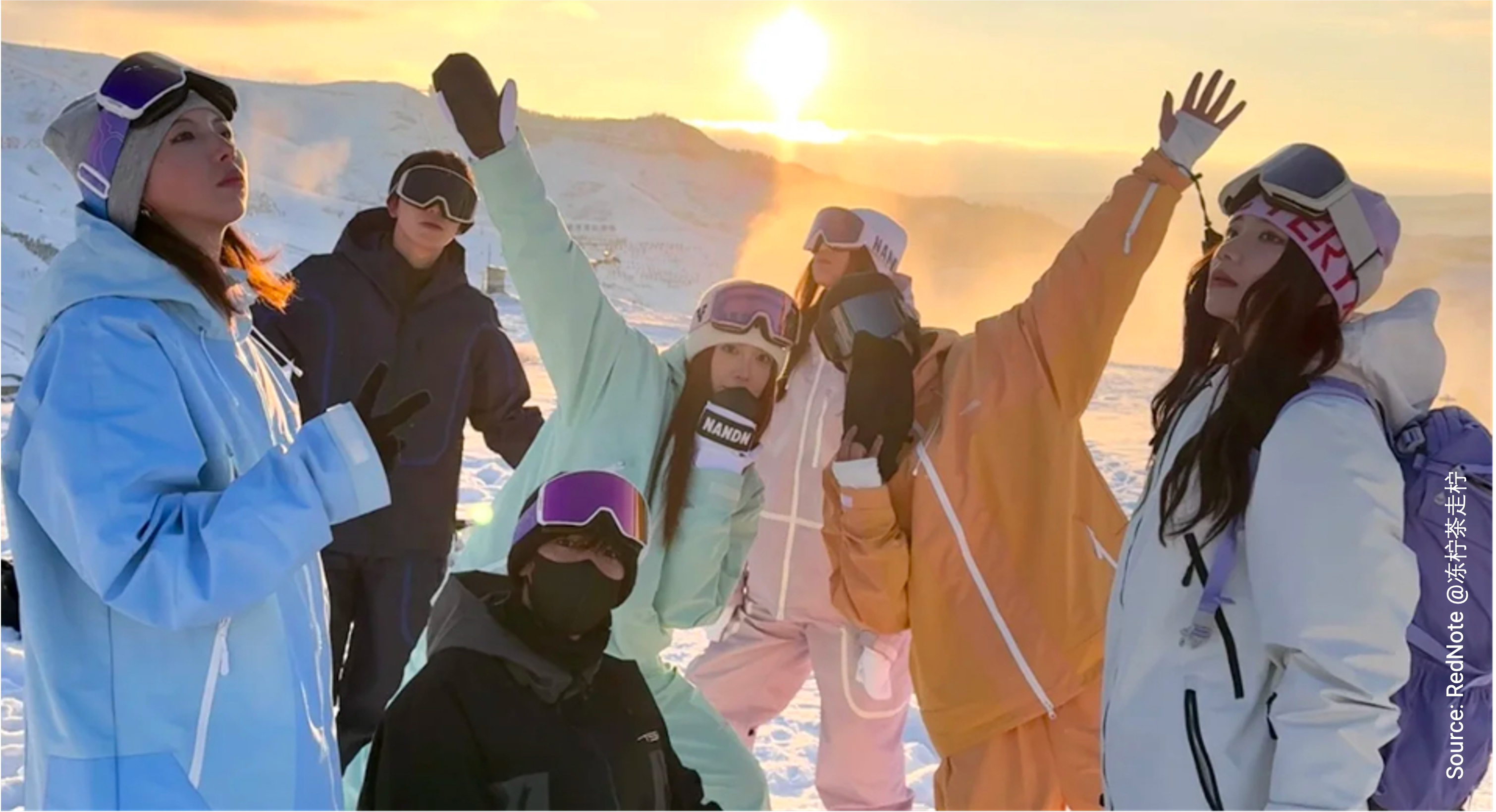
As the 2026 Winter Olympics ended, the Chinese winter sports market is once again experiencing a surge of intense fever, proving that the momentum generated by Beijing 2022 was not a passing trend but a catalyst for sustained growth. On Rednote, under the topic #Milan Winter Olympics#, there are 2.2 million related notes and 893.5 million views. While digital platforms are filled with discussion over athlete performances, consumers are paying unprecedented attention to the apparel worn by Chinese Olympians. This trend highlights a development in the industry, as Lining and Anta, sponsors of the national team, have bridged the gap between functional performance and high fashion. These branded kits are not just uniforms; they are becoming the fashion statements on Chinese social media, signaling a new era where technical gear defines cultural identity.
Download our report on China’s winter sports market:

Market size and growth of the Chinese winter sports market
Since successfully hosting the 2022 Beijing Winter Olympics, China has transformed winter sports from a niche activity into a rapidly expanding commercial sector, fulfilling the government’s ambitious goal of engaging 300 million participants. The strong momentum in the Chinese winter sports market is closely linked to the broader ice and snow industry. Valued at RMB 980 billion in 2024 and surpassed RMB 1 trillion in 2025, the ice and snow industry has been fueled primarily by the rapid expansion of tourism, which is expected to attract 360 million visits during the 2025–2026 season alone. As participation continues to rise, demand for specialized and high-performance equipment has accelerated. The winter sports market is therefore projected to grow from USD 17.78 billion in 2025 to USD 23.65 billion by 2030, representing a compound annual growth rate (CAGR) of 5.87%.

Rising ownership rates and surging sales indicate a maturing consumer base
Since the start of the 2025 snow season, sales data further reflect this growth momentum. Revenue from ski apparel has increased by more than 50% year-on-year, while ski equipment sales have risen by over 30%. In 2025, on Douyin, one of the major e-commerce platforms in China, the ice and snow-related group-buying orders surged by 98% year-on-year. As 15.66 million users expressed purchase interest, it represented a 79% increase compared to the previous year. These figures suggest that winter sports consumption is not merely driven by short-term Olympic enthusiasm but is increasingly supported by a growing and engaged consumer base.
According to survey data (N=1,150, 2024) on China’s winter sports market, approximately 61.5% of winter sports participants purchase their own equipment, while only 38.5% rely on rentals. Among those who buy equipment, 25.8% spend between RMB 501 and 1,000, 43.5% spend between RMB 1,001 and 2,000, and 16.0% spend between RMB 2,001 and 3,000. Additionally, 72.8% of consumers report satisfaction with their purchases in ski apparel. These findings suggest that consumers are increasingly willing to invest in winter sports equipment rather than treat participation as a one-time experience. The high ownership rate reflects a deeper commitment to the sport and indicates strong long-term growth potential for the market.

Three key catalysts fueling market momentum
The growth of the Chinese winter sports market is powered by three main government-supported catalysts. The Beijing 2022 Legacy acted as the starting point; extensive national promotion, combined with the star power of icons like Eileen Gu, Mingyi Su, Mengtao Xu, and Dajing Wu, converted millions of spectators into active participants, particularly in skiing. Following the Games, the General Administration of Sport accelerated this momentum by optimizing the supply of winter events. They construct a multi-layered structure of international and domestic competitions, including specialized programs for youth, which drove a 50% increase in domestic events during the 2023–2024 season compared to the previous year.
The second major catalyst, the Harbin 2025 Asian Winter Games, has further solidified the northeast region’s position as China’s winter heartland. The broadcast of these events has heightened the profile of Harbin’s ice resources among enthusiasts, with strategic post-game venue conversion aimed at sustaining a year-round influx of domestic and international tourists.
The Milan 2026 Winter Olympics further generated a new wave of enthusiasm. This momentum is driven by continued athlete star-making effects, especially Mingyi Su and Eileen Gu, technological advancements among Chinese winter sports brands, and increasing cultural resonance—particularly as domestic brands incorporate Chinese design elements into competition apparel worn by national athletes. Together, these factors are reinforcing national pride while strengthening the global competitiveness of Chinese winter sports brands.
The rise of “China Tech”: Domestic brands targeting the high-end
To capture a greater share in Chinese winter sports market, domestic brands are shifting from a volume-driven growth model toward a value-oriented strategy. In particular, companies are increasing investment in technological innovation to narrow the quality gap in high-end equipment, a segment that has traditionally been dominated by European and American brands. This strategic transition is further supported by rising national recognition of domestic brands. The Milan 2026 Winter Olympics provide an important international platform for visibility. Notably, Anta Group served as the official outfitter for 13 Chinese national teams, reinforcing the national pride of the Chinese domestic brands.

Material science and R&D drive domestic brand premiumization
Technological advancements are reinforcing the premium positioning of domestic winter sports brands. For example, Anta’s latest speed skating suits integrate a proprietary drag-reduction system that improves aerodynamic efficiency by 1.49%. In high-performance apparel, aerospace-derived insulation materials have been incorporated into customized competition suits, including those worn by Eileen Gu. Innovation is also accelerating in equipment manufacturing. Jilin Chemical Fiber Group is a company that independently developed large-scale carbon fiber production capabilities. It applies advanced carbon fiber materials to snowboard manufacturing. Snowboards produced with this material are at least 20% lighter and 30% stronger compared to conventional alternatives.
In addition, Changchun Shengwei Yate Suit & Dress has collaborated with the Key Laboratory of Ice and Snow Sports at Northeast Normal University to improve product performance through research-based development. The partnership focuses on optimizing winter sports apparel for Chinese body characteristics using data-driven design, incorporating biometrics and thermal physiology to enhance comfort, fit, and protection. Such collaboration between manufacturers and research institutions reflects a broader shift toward integrating advanced production capabilities with user-oriented product development. This approach supports the ongoing upgrading of domestic brands, particularly in higher-value segments where consumers increasingly prioritize functionality alongside brand positioning.
How brands compete in the Chinese winter sports market
Domestic winter sports brands are leveraging technological advancements to break into higher price tiers. Meanwhile, foreign brands in China are doubling down on their heritage and cultural identity to differentiate themselves in the competitive landscape. Their strategy centers on combining international technical credibility with localized storytelling that resonates with Chinese consumers.
Arc’teryx provides a representative example. In its documentary campaign, The Taoism of Ski Mountaineering, the brand connected high-performance ski mountaineering with traditional Chinese philosophy. By framing ski movement as a balance between softness and rigidity, it references the Taoist concept of “goodness akin to water” (上善若水). The campaign generated significant online engagement, reaching over 16 million views across platforms, including 1.5 million views on RedNote.

In addition to cultural storytelling, Arc’teryx has strengthened brand influence through active celebrity participation. For example, Wang Yibo’s ascent of the 4,000-meter Yalong Glacier while wearing Arc’teryx gear attracted substantial consumer attention. This case illustrates how experiential celebrity endorsement may generate stronger engagement than traditional static advertising formats.
The brand has also invested in offline experiential marketing. At Songhua Lake in Jilin, Arc’teryx launched its first global RSC (ReBird Service Center) snow resort pop-up experience space. Although the installation drew criticism from some Chinese netizens regarding its environmental impact, particularly due to the fireworks display, the related topic #Arc’teryx ReBIRD# still generated over 3.9 million views and more than 5,000 user posts on RedNote.

Strategic takeaways from China’s evolving winter sports market
After the Milan 2026 Winter Olympics, the Chinese winter sports market appears to be transitioning from entry-level participation to more performance-oriented and specialized consumption. Industry trends indicate that winter sports are increasingly extending beyond seasonal activities, supported by the development of large-scale indoor snow facilities in southern metropolitan areas. This geographic expansion contributes to more consistent, year-round demand for technical equipment as well as lifestyle-oriented winter apparel.
For international brands, cultural adaptation is becoming an important competitive consideration alongside technical capability. As the market matures, product localization, including adjustments in fit, insulation standards, and ergonomic design, may enhance relevance for Chinese consumers across different regions. In addition, collaborative digital campaigns and partnerships with local influencers are emerging as effective channels for brand engagement.
China’s booming winter sports market
- The Chinese winter sports market is experiencing structural growth rather than a temporary Olympic-driven spike. The continued momentum following Beijing 2022 and renewed attention around Milan 2026 indicate sustained long-term expansion.
- The market is expanding in scale while simultaneously moving up the value chain. Rising equipment and apparel sales reflect increasing demand for premium and performance-oriented products.
- Consumer behavior suggests long-term commitment rather than trial participation. With over 60% of participants purchasing their own equipment, the market shows strong retention and repeat consumption potential.
- Domestic brands are rapidly strengthening their technological capabilities and moving into higher-end segments. As the performance gap narrows, competition is shifting from pure technical superiority to brand positioning and innovation.
- Foreign brands remain competitive by leveraging cultural storytelling and experiential marketing. Localized engagement strategies are becoming as important as product performance in driving brand relevance in China.