

In China’s convenience store industry, companies face rising price sensitivity, traffic shifting to discount snack stores, and intensifying competition from instant retail. In 2025, although 66.1% of companies achieved year-over-year sales growth, the momentum slowed compared to the previous two years. 81.4% and 70% of companies experienced growth in 2023 and 2024, respectively. Sales growth is supported by both existing stores and new store openings, although same-store performance remains largely flat. This suggests that overall growth is increasingly driven by expansion and new channels rather than stronger demand per store. Therefore, convenience stores in China are responding by focusing on product appeal, operational efficiency, and the development of their own brands. Given their role in frequent, low-cost, and impulse purchases, convenience stores are naturally positioned to capture this demand for small, everyday emotional rewards.
Download our China F&B White Paper
Offline stores face weakening performance and declining traffic
Despite growing challenges, China’s convenience store industry reached RMB 503.3 billion in 2025, a compound annual growth rate of 15.6% since 2015. In 2026, it is expected to grow to RMB 541.0 billion.
E-commerce has become a core driver of growth, with 67.9% of companies reporting a YoY increase in online orders. Among them, 46.4% saw online sales growth of over 10%, a significant increase from 26.7% in 2024. However, operational pressures at comparable stores have become apparent. Only 26.8% of companies reported sales growth at existing stores, while approximately half saw a decline in store visits. This coincides with the combined impact of competition from discount snack stores and the continued shift of consumer behavior toward online shopping.

Convenience store expansion accelerates with higher density and policy support
The competition landscape is characterized by local giants taking the lead, foreign players with deep-rooted operations, and regional leaders dominating their respective markets. Meiyijia, a domestic Chinese convenience store chain, has become the industry leader with over 40,000 stores, opening its 40,000th location in Nanning, Guangxi, in July 2025. Among foreign brands, Lawson continues to advance its localization strategy, with over 6,000 stores. FamilyMart is accelerating its expansion into Tier 2 and Tier 3 cities in the Yangtze River Delta region.
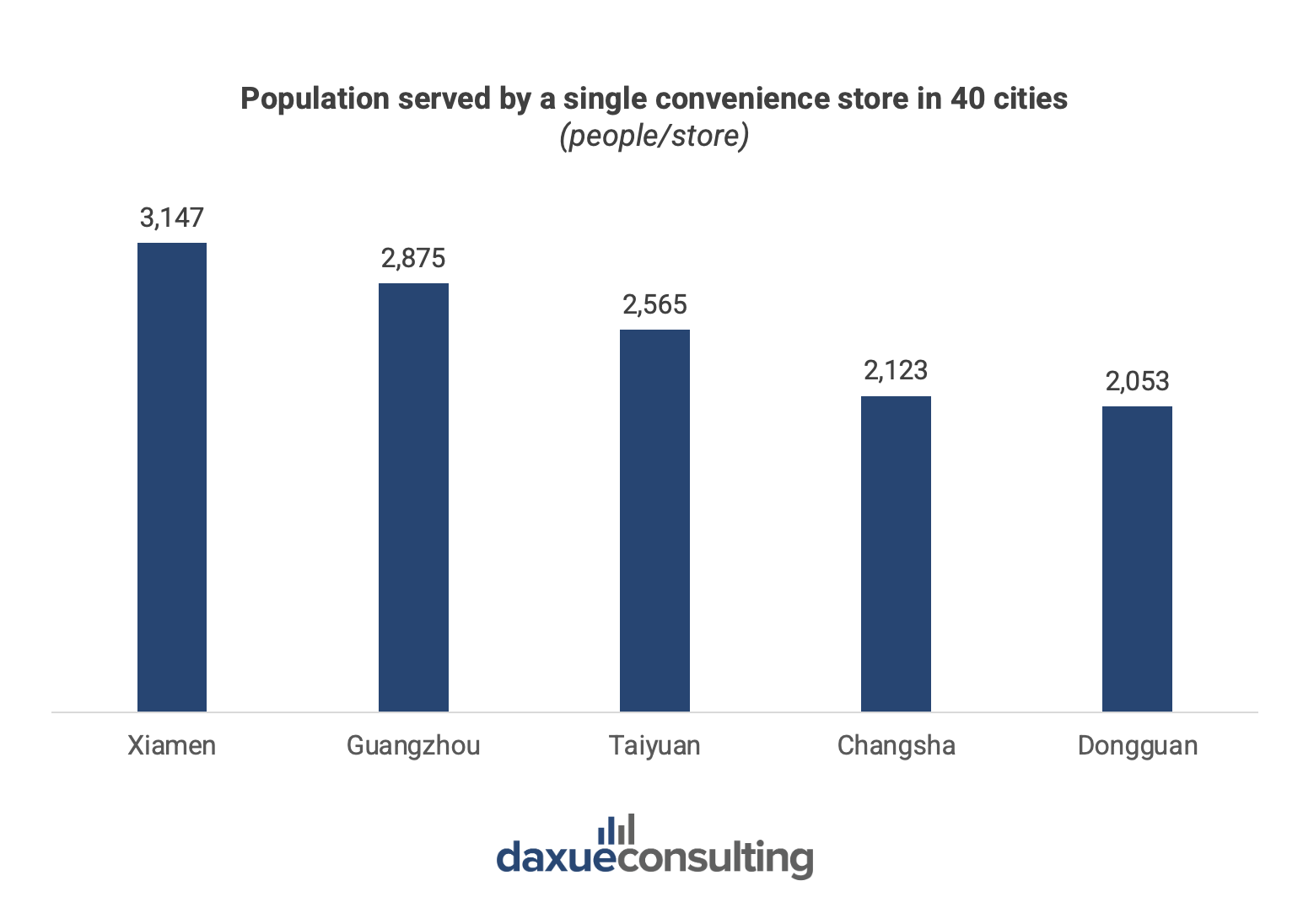
China’s convenience store network continued to increase in 2025, with one store serving 6,721 people on average. The cities with the highest store density were Dongguan, Changsha, Taiyuan, Guangzhou, and Xiamen.
Over half of stores (53.4%) now operate 24/7, with Guangzhou leading the way at 78%. The widespread adoption of unmanned technology has effectively reduced overnight operating costs. In addition, the government continues to promote policies aimed at establishing 15-minute convenience zones in cities, and supporting policies in various regions have further improved the business environment for convenience stores.
Turning convenience stores into mini supermarkets
In recent years, convenience stores in China have begun to move beyond the traditional model of small and specialized shops. By expanding store space, introducing fresh produce, and expanding their selection of family-sized products, they are increasingly transforming into multifunctional community supply stations. What drives this trend is consumers’ redefinition of convenience. Many are no longer concerned solely with whether they can shop at any time, but place greater emphasis on being able to buy everything they need in a single trip.
This trend is driven by multiple factors. Expanding store space and adding high-margin products such as fresh produce not only increases the average purchase amount but also strengthens community engagement. In addition, the expansion of Chinese fresh food delivery platforms, such as Hema Fresh, which offer low-priced fresh produce in residential areas, has intensified competition and drawn consumers away from convenience stores. In response, convenience stores are expanding their fresh produce and daily essentials offerings to stay competitive. Jinan’s “INZONE CC” is a prime example, positioning itself as a hybrid of a community supermarket and a convenience store. It offers household essentials such as fruits, vegetables, meat, and poultry, while also expanding its selection of ready-to-eat foods like freshly brewed coffee and oden.
Convenience stores and supermarkets complement each other in the community retail ecosystem
Although convenience stores are expanding into some supermarket-like categories, there are still clear differences between the two. Regarding supply chain models, convenience stores adopt a selective approach, stocking only the most frequently purchased fresh fruits and vegetables for daily household use, and ensuring rapid restocking. This allows them to meet immediate demand while keeping waste within manageable limits. Supermarkets, on the other hand, carry hundreds of varieties of vegetables, which requires a robust system of direct sourcing from producers and a cold chain to support.
Consumers typically visit convenience stores to meet immediate restocking needs, while supermarket visits are more often planned. This difference also means that the two business formats are not necessarily direct substitutes, but rather complementary within the community retail ecosystem.
Localization of the convenience stores
China’s convenience stores are beginning to move beyond the standardized nationwide distribution model, actively integrating local food culture and introducing products with strong regional characteristics. This approach not only satisfies consumers’ dual desire for the flavors of home and new experiences, but can also attract tourists by offering them a more convenient way to experience the local food culture. These localized products are deeply rooted in local culinary traditions, and this regional distinctiveness is more difficult for competitors to replicate at scale.
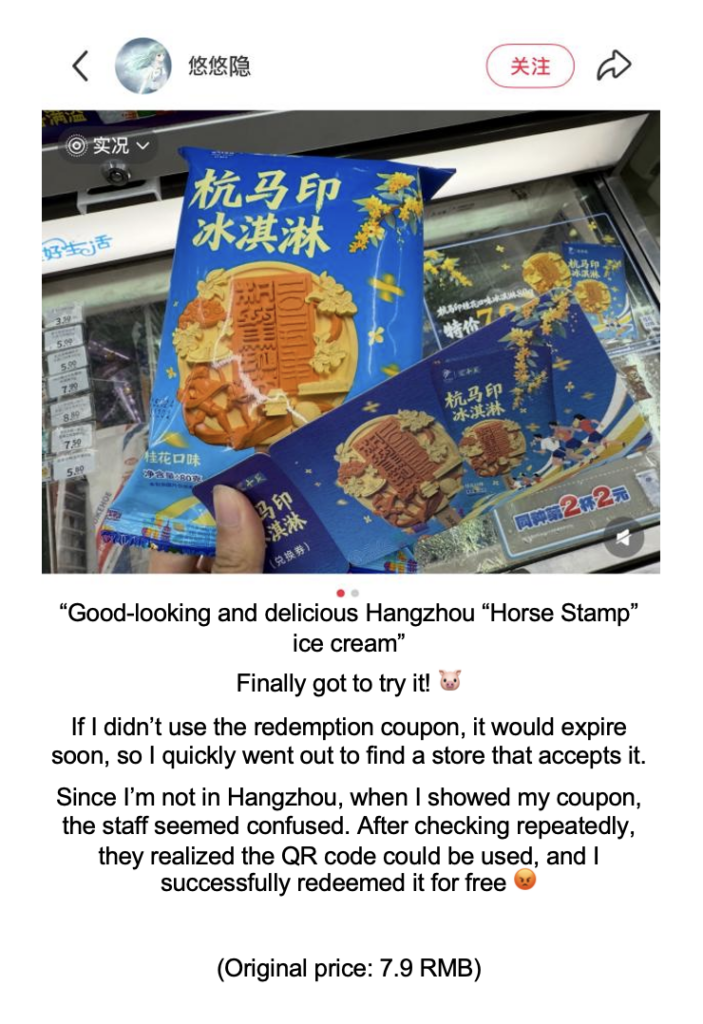
This trend presents in two forms. First, grassroots culture created by consumers themselves, such as young people in Guangzhou mixing Guo Li Fang (fruit wine made with Chinese baijiu as the base spirit), Tian Di Yi Hao (local apple cider vinegar drinks), and Pineapple Beer, to create a local concoction, turning convenience stores into DIY cocktail labs. The second one is brand-driven innovation, such as the Hangzhou Marathon Edition osmanthus-flavored ice cream launched by Shizu in collaboration with the 2025 Hangzhou Marathon.
Regardless of the form it takes, localized innovation helps create a sense of novelty in products, enabling companies to stand out in today’s market, where products are increasingly similar. Moreover, the product’s strong regional character and cultural and creative appeal naturally inspire consumers to take photos and share them, contributing to viral marketing. By transforming local characteristics into consumer experiences, convenience stores are becoming important channels for spreading local culture and connecting with the community.
Convenience stores evolve to deliver emotional value
Convenience stores are increasingly becoming emotional refueling stations. This trend arises from a significant evolution in purchasing motivations. Consumers are placing greater importance on self-worth and emotional fulfillment. As a result, products that resonate on a personal level have become key to winning them over.
According to Nielsen IQ in 2026, emotional factors have become an important driver of consumer purchasing decisions. 77% of consumers expect products to provide emotional value, 36% purchase items for leisure and relaxation, and 36% seek to treat themselves. 75% of consumers are willing to try new products at convenience stores, making them a key testing ground for brands launching new items.
Amid economic cycles and mounting pressures, the younger generation seeks instant and low-cost emotional fulfillment. They trade a minimal investment for instant joy through the combination of a cup of coffee and a lottery ticket, which has become an emerging leisure choice for many young Chinese consumers. In Hanshan County, Anhui Province, a county-level convenience store saw weekend customer traffic increase by nearly 50% and the proportion of overnight revenue rise from 10% to 30% through an interactive marketing campaign featuring lottery tickets and blind boxes.
In an era of extreme abundance in consumer goods, consumers place greater emphasis on the emotional experience and psychological satisfaction during the consumption process. Therefore, providing consumers with emotional value aligns with modern business trends. The core of convenience store competition no longer revolves solely around who offers the widest selection or the deepest discounts, but rather who truly understands people, who can be ever-present in daily life, appear at just the right moment, and provide a sense of security and convenience.
Convenience stores are redefining consumer value for long-term growth
- In 2025, China’s convenience store industry continued to expand steadily despite multiple pressures. The market size reached RMB 503.3 billion, with a CAGR of 15.6% since 2015.
- Convenience stores are increasingly moving beyond the traditional small-scale, specialized model. They are expanding their floor space, introducing fresh produce, and expanding their selection of family-size products, thereby transforming into community supply stations.
- In China’s food and beverage market, convenience stores are incorporating local food cultures and introducing products with regional characteristics.
- Convenience stores have evolved from simply selling products to delivering emotional value, meeting consumers’ emotional needs.