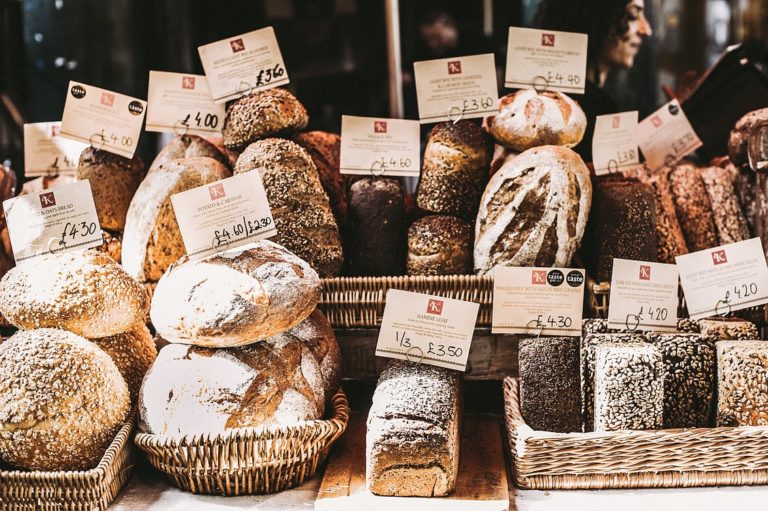

China’s bakery industry is characterized by extreme competition and diversity, exemplified by a massive disparity in pricing strategies. In cosmopolitan hubs like Shanghai, consumers frequently wait hours and spend upwards of RMB 100 for artisanal, specialized toast. Conversely, on dominant e-commerce platforms like Taobao, top-selling items offer 1kg of toast for just RMB 15. This stark contrast highlights a market bifurcated between high-end experiential consumption and high-volume, affordable staples, both of which cater to distinct consumer segments.
Download our China F&B White Paper
The size and distribution of China’s bakery industry
China’s bakery industry has experienced rapid expansion in recent years. From approximately RMB 4,74.52 billion in 2021, the market continued to grow steadily, reaching RMB 611.07 billion in 2024, driven by rising consumer demand and diversification of retail channels. It is projected to expand further to about RMB 859.56 billion by 2029, growing at a compound annual growth rate (CAGR) of around 7.3 % over the period. Compared with much higher per-capita bakery spending in countries like France (about RMB 2,350) and Japan (about RMB 1,446), China’s per-capita bakery expenditure is significantly lower (around RMB 188), suggesting that China’s bakery industry still has substantial room to grow as consumption habits and incomes continue to rise.

Beyond overall growth, consumer behavior reveals a deeply entrenched purchasing pattern in China’s bakery industry. Data shows that 90.6% of consumers now purchase bakery products at least once per week, with 2.0% buying them daily. Admittedly, China’s per capita expenditure remains lower than in mature markets like France or Japan, primarily because bakery items are priced as accessible staples rather than expensive luxuries. However, this affordability is exactly what fosters high-frequency habits, creating a resilient, volume-driven foundation with greater long-term growth potential than a reliance on occasional premium purchases.
The importance of quality in success
To succeed in China’s bakery industry today, the quality and health profile of ingredients have become the ultimate competitive advantage. Recent market trends show a decisive shift toward food quality and health benefits, as consumers now prioritize intrinsic substance over pure aesthetic appeal. When purchasing bakery products, Chinese consumers focus primarily on three factors: taste and texture (44.3%), freshness (43.2%), and nutrition (39.6%). This demand for wellness has driven retailers to invest heavily in healthy product lines, such as whole wheat, zero-added sugar, and low-fat options.

Elevating ingredient standards: The dominance of premium dairy
Among all components, dairy quality has emerged as the most critical factor for success. According to a 2024 survey (N=3,000, ages 18-59), over 40% of consumers specifically look for “famous brand ingredients” (such as President or Anchor butter), “organic ingredients,” and the use of “animal-based cream” (动物奶油). High-income earners and multi-child families show the strongest preference for these characteristics. These consumers frequently seek out products that are “generously made” (用料足), characterized by high butter content over 15% and raw milk additions exceeding 30%.
This shift toward premium dairy in China’s bakery industry is further reinforced by the Chinese government’s regulatory landscape. The implementation of the “National Food Safety Standard for Cream, Butter, and Anhydrous Milk Fat” (GB 19646-2025) in March 2025 establishes a more scientific fat content benchmark and clearly distinguishes “cream” from “prepared cream.” By prohibiting the addition of vegetable oils and strictly regulating the labeling of fermentation and acidification processes, this policy standardizes the definition of animal cream. Consequently, these regulations are pushing the entire bakery market to evolve into a more regulated, high-quality, and health-conscious industry.

Strategic market positioning and the pricing bifurcation
Market positioning and price are also essential for success in China’s bakery industry. According to a survey (N=1,496), the highest percentage of consumers (40.1%) spend between 21–40 RMB per visit, followed by 23.3% who spend 41–60 RMB. This shows that while the majority do not spend excessively, there is a distinct segment willing to pay for high-quality products. As a result, China’s bakery industry has bifurcated into two trajectories: hyper-specialized luxury in Tier-1 hubs and industrial expansion in lower-tier cities.

In Tier-1 cities, especially Shanghai, a “single-category” trend has emerged, where specialized stores focus on specific products like toast or bagels to create high brand value. This is characterized by “extreme” pricing—with some toast reaching RMB 98 and average bagel orders exceeding RMB 50—and intense social media hype that drives three-hour queues. While these “celebrity” shops currently dominate social listening, the high prices raise questions about whether this is a sustainable shift or a passing fad that will fade once the “check-in” culture dissipates.
Indeed, behind this apparent prosperity, sustainability challenges remain. Notable brands like Gontran Cherrier withdrew from the Chinese market in mid-2025, and local favorite Zhengaoxing (珍糕兴) shuttered its last Shanghai store due to unmet performance expectations, illustrating the difficulty of translating social media hype into long-term profitability.
The “Sinking Market”: China’s bakery growth engine
In stark contrast to this volatile, high-end landscape, the “sinking market” in lower-tier cities has become the primary growth engine for large-scale bakery factories. As of the first half of 2025, third-tier cities accounted for 25.4% of bakery stores, while fourth-tier cities and below reached growth rates of 18%. With per capita consumption in these regions rising by 12% annually, China’s bakery industry is shifting toward high-volume, standardized production. This industrial expansion suggests that mass-market accessibility is the more viable long-term strategy. By maintaining a lower price, these products transition from occasional luxuries into daily life necessities, securing a much larger and more loyal customer base compared to the volatile, “one-off” nature of premium specialty shops.

Digital transformation and the e-commerce-driven ecosystem
In a nation where retail is synonymous with digital integration, e-commerce has become a cornerstone of success in China’s bakery industry. The expansion in the market is largely fueled by emerging models such as livestreaming and community group buying, which contributed to an annual growth rate exceeding 40%. Among these platforms, Douyin has emerged as the dominant force, capturing 56% of the market share in 2024. This rise comes at the expense of traditional giants like Taobao. The market share plummeted from 57% in 2022 to just 29.7% in 2024.
Beyond direct sales platforms, RedNote plays a vital role as a marketing engine that bridges the gap between digital discovery and physical consumption. Massive engagement in topics like #BreadReview (面包测评, 821.6 million views) and #BreadLovers (面包控, 6.0 billion views) allows KOLs and everyday consumers to share authentic feedback on taste and quality. These social signals act as a powerful traffic driver, directing users to purchase either in-store or online.
The efficacy of the digital-to-physical pipeline is heavily reliant on logistics because bakery items are highly perishable. Success is dictated by the “delivery radius,” as even viral products can only convert interest into sales if they are within an effective coverage area that ensures freshness. Consequently, the top sellers on e-commerce platforms are predominantly large-scale bakery factories with superior infrastructure, such as Three Squirrels (三只松鼠), Holiland (好利来), and Panpan (盼盼). These brands maintain warehouses across multiple cities or utilize high-speed delivery systems to scale nationwide, overcoming the limitations of single-store distribution.
China’s bakery industry: From niche hype to daily necessity
- Chinese bakery products have transitioned from occasional treats to daily essentials. It is driven by a deeply entrenched purchasing habit among the vast majority of consumers.
- Market success is now defined by ingredient integrity and a shift toward premium dairy. The trend is reinforced by the implementation of stricter national food safety standards.
- The industry has bifurcated into a dual-track landscape characterized by high-end specialized niches in major cities and massive industrial expansion in lower-tier “sinking” markets.
- While luxury “celebrity” shops often face sustainability issues due to extreme pricing, mass-market models offer greater long-term stability by transforming bread into an affordable daily necessity.
- E-commerce and social media platforms are the primary drivers of brand discovery, but long-term dominance belongs to large-scale players with the logistical infrastructure to ensure nationwide freshness.